Want to learn more about figure skating history? You are in the right place!

Created in 2013, Skate Guard Blog explores the overlooked, forgotten, and underappreciated corners of figure skating history - from little-known stories to fresh perspectives on famous skaters, eras, and events. There’s always something new to discover, so grab a cup of coffee and glide into the rich, fascinating history of the world’s most beloved winter sport.

Launch Day: Your Ultimate Guides to the World & European Figure Skating Championships

Think you know figure skating history? Think again.

I'm thrilled to launch a brand-new Collector's Edition Set lovingly compiled for figure skating fans to want to take a deep dive into the history of the World and European Figure Skating Championships. 


Together, these two books are the ultimate references for fans, historians, and anyone who loves the sport. These books are the result of meticulous research of original sources, capturing details that you simply can’t find online.

Sure, you can search for past results on the internet - but early records are often incomplete and  sometimes inaccurate. If you want to learn the real history of the oldest continuous international figure skating competitions in the world, these are the books for you.

Why You’ll Love This Set:

- Every Result, Every Champion - From the very first World and European Figure Skating Championships in the 19th Century to today's stars, every competition is documented with complete results, facts and firsts.

- Rare Photos - Curated black & white photographs highlight the evolution of figure skating over the decades.

- Stories Behind the Scores - Trivia, anecdotes, and historical context about the two oldest continuous international figure skating competitions in the world.

This Collector's Edition set is a wonderful keepsake for anyone passionate about the sport who wants to fully understand the history and evolution of the two of the most decorated figure skating competitions in the world.

Order Your Set Today! Available in paperback and hardcover formats where books are sold.

Remembrance Day: Honouring Canadian Skaters Who Served

On November 11, 1918, the Armistice signed near Compiègne, France brought an end to the fighting of the  The Great War on the Western Front.

Members of the Canadian figure skating community have long answered the call of duty, dedicating themselves to their country during both World Wars. From national and North American champions to judges, coaches, club leaders, recreational skaters, and family members of some of Canada’s most celebrated skaters, countless individuals served in the military or contributed to essential war efforts.

To honor their courage and sacrifice, Skate Guard presents a special Veterans' Week page for Remembrance Day, celebrating the wartime contributions of these remarkable men and women.

Frozen Footnotes From Figure Skating History

Figure skating has always been a sport full of surprises - glittering triumphs, forgotten milestones, and moments so unusual they defy easy categorization. Some stories are well-known; others have slipped quietly through the cracks of time. But all of them, in their own way, reveal the charm, chaos, and character that make skating's history so compelling.

Over the years, I've collected a handful of tales that didn't quite fit anywhere else - too short for a full post, but too interesting to leave untold. I hope you will find these interesting!

ŚLIZGAWKA W ŁAZIENKACH: THE LOST FILM


You’ve probably never heard of Ślizgawka w Łazienkach - yet it may have been the one of the very first films ever made in Poland, and quite possibly one of the first moving pictures of figure skating. Filmed between 1894 and 1896 by inventor and cinematography pioneer Kazimierz Prószyński, it captured skaters gliding over the ice at the Warszawskie Towarzystwo Łyżwiarskie (Warsaw Skating Association), founded just a year earlier. Using his handmade “pleograph,” an early motion picture camera of his own design, Prószyński filmed scenes of winter life that enchanted Warsaw audiences when screened in 1902 alongside another short skating film, Ślizgawka w Dolinie Szwajcarskiej (“Skating in Swiss Valley”). These silent glimpses of skaters at play were early marvels of motion - long before the Lumière brothers’ films became household names.

Then, just as suddenly as they appeared, they vanished. For decades, the films were thought lost - perhaps destroyed by Prószyński himself to protect his inventions, or obliterated during World War II when the filmmaker perished in a Nazi concentration camp. Today, only four still images survive, ghostly echoes of what was once a landmark in both cinema and skating history. Their disappearance is a haunting reminder of how fragile the record of our past can be - and how easily even the brightest moments on ice can fade if they aren’t preserved.

THE CASE OF THE MISSING PROGRAMS

Photo courtesy "Skate" magazine

In December 1985, the World Junior Championships returned to Sarajevo's Zetra Ice Rink - the same arena where the world's top figure skaters had dazzled thousands just a year earlier during the 1984 Winter Olympics. But when skaters and officials arrived, something strange was afoot. They received beautifully printed event programs, yet not a single one was available for spectators - despite the fact that ten thousand copies had supposedly been printed.

Souvenir pins, a staple at every international event, had also been produced in large numbers - but mysteriously, only a handful ever made it to the merchandise table. Whether it was a bureaucratic mix-up or a logistical disaster, the audience was left empty-handed.

LATVIAN SKATING SPIES IN THE COLD WAR?


"The trouble," wrote Ukrainian poet Pavlo Tychyna in 1962, "is that there are some among the young poets who do not understand what it means to be an innovator... they are just twisting around like skaters pirouetting on ice." In Communist countries, that metaphor hit close to home. From the Soviet Union to China, figure skaters were often viewed with a certain air of suspicion - glamorous symbols of Western culture who moved too freely and beautifully for comfort. Katarina Witt was shadowed by the Stasi. The Protopopovs were monitored by the KGB. And, as it turns out, the spy games on ice ran even deeper than anyone imagined.

Declassified intelligence files reveal how skating was occasionally entangled in Cold War intrigue. A 1954 Nepalese intelligence report described Soviet diplomats slipping into Japan under the cover of accompanying a skating team - only for the two nations to resume diplomatic relations months later. 
Another file from 1955 told of Albert Feierabend, a Latvian skater turned Soviet agent caught entering the U.S. with a false passport and $28,000 hidden in his belt.
 
The letters of a Latvian coach named Lidija Gailis were monitored for clues about skating "contests" in Riga, and it was suspected at the time that Gailis and her husband Imants were actually Albert Feierabend and his wife Emma. The fact that a skating coach at the Sports Society 'Daugava' was being monitored by the CIA in the 1950s was certainly intriguing.

Whether coincidence or cover, these stories remind us that behind the elegance of a perfect spiral sometimes lurked the chill of espionage - and history may still have a few more frozen secrets left to uncover.

BEGIN THE BEGUINE


The Starlight Waltz, Tango Romantica, Silver Samba, Paso Doble - names that immediately spark recognition among ice dance fans. These compulsory dances were performed thousands of times by the world's best ice dancers over the years. Yet not every dance caught on in the same way.


Take the Beguine, a flirtatious foxtrot/rhumba from the Caribbean, made famous in the U.S. by Fred Astaire and Eleanor Powell dancing to Cole Porter's "Begin the Beguine" in 1940. It wasn't until 1957 that British ice dancer Robert Dench brought it to the rink, crafting a foxtrot-style pattern with intricate lobes, progressives, and chassés. 

Despite its clever design and international flair, the Beguine never caught on. Today, the Beguine remains a fascinating footnote in ice dance history - a short-lived reminder that for every compulsory dance that caught on, there were dozens of others that didn't.

TAIWAN MEETS SWITZERLAND

Founded in 1973, the Chinese Taipei Amateur Skating Association took a decade to join the ISU, officially becoming a member in 1983. By 1990, the Association had grown to twelve skating clubs with 250 members. In 1986, at the World Championships in Geneva, Pauline Lee made history as the first skater from Taiwan to compete at a senior ISU event. She didn’t advance to the free skate, but she also didn’t finish last either, marking an important first step on the international stage.

But the story of Taiwan’s debut at the World Championships that year goes far beyond Lee’s historic appearance. In the "Skate" magazine yearbook of 1986, British sportswriter Sandra Stevenson recalled, "The boy from Taiwan apparently got sick on his flight from the United States where he had been training. Another boy who was not the named reserve, and therefore could not have competed, was allowed into a practice session under the misunderstanding that he was the original skater. This boy was so overwhelmed with the standards of the Soviets, with whom he had to share practice, that he hardly skated. When he did venture out, he got muscle cramps from skating on such a large rink and was withdrawn due to injury. The rink in Taipei is very small and has columns in the middle. That is nothing to the problems the skaters from Hong Kong have to deal with. A Canadian coach who went to Hong Kong to help their skaters found their biggest problem was getting the chicken coups off the rink. It seems the local merchants find the ice their most convenient source of refrigeration. After their extremely poor display last year, the skaters from Hong Kong did not turn up this time. The Taiwanese skaters are referred to as coming from the Republic of Taipei so as not to antagonise the competitors from Mainland China... A special flag was flown instead of the Taiwanese insignia and in the extremely remote chance that a Taiwanese competitor wins, a special anthem has been composed."

Skate Guard is a blog dedicated to preserving the rich, colourful and fascinating history of figure skating. Over ten years, the blog has featured over a thousand free articles covering all aspects of the sport's history, as well as four compelling in-depth features. To read the latest articles, follow the blog on FacebookBlueskyPinterest and YouTube. If you enjoy Skate Guard, please show your support for this archive by ordering one of eight fascinating books highlighting the history of figure skating: https://skateguard1.blogspot.com/p/buy-book.html.

Never Forgotten: The Freddie Tomlins Story


"Smart lad, to slip betimes away / From fields where glory does not stay / And early though the laurel grows / It withers quicker than the rose." - Excerpt from "To An Athlete Dying Young", A.E. Housman, 1896

"Wherever he performed, his exhibitions of dauntless skill and courage captivated the crowds. His ingenuity was such that he could do almost anything on skates. How sad that he should have lost his life at this point of his career, fighting for his country's cause for freedom." - Henry Graham Sharp, "The Skater" magazine, 1949

Frederick 'Freddie' William Edwin Tomlins was born August 5, 1919, to Ernest and Grace Halcyon (Pye) Tomlins in Lambeth, England. When Freddie was only seven months old, the family relocated to Canada as his father was serving in the Canadian Army. Freddie's father, grandfather and great-grandfather were all leather dressers by trade.

While in Canada, Freddie's younger sister Margaret (Peggy) was born. The Tomlins family returned to England in June of 1923, taking up residence on Upper Grange Road, Bermondsey, South London.

Freddie was an athletic child who excelled at swimming, diving, boxing, tennis, running, football and cricket. Ernest, equally sports-minded, was a former boxing instructor, tennis champion, hockey player... and ice skater. When Streatham Ice Rink opened, he brought little Freddie and Peggy along and began showing them the ropes. Soon, both Tomlins children began taking lessons from Ernest Batson, and then Phil Taylor, the father of World Champion Megan Taylor.

Joy Ricketts and Freddie Tomlins

By the age of thirteen, Freddie passed his N.S.A. bronze test and began competing and skating exhibitions as a pairs skater with Joy Ricketts, taking from Eugen Mikeler and Nate Walley. He also found success as a speed skater, setting records of 1 min, 24 1/2 seconds for the half-mile and 2 mins, 51 and 1/5 seconds for the mile, both unpaced. In no time, Joy and Freddie won the Count de la Feld Challenge Trophy for junior pairs skating.


Though undeniably a talented pairs and speed skater, what really caught people's attention about Freddie was his fearless free skating. He was actually so popular with other skaters that they would often travel from other rinks just to watch him practice. He began training seriously as a singles skater at Westminster Ice Rink under the tutelage of Howard Nicholson. In 1933, he became the first skater in Great Britain to earn the N.S.A.'s Silver Medal in both figure and speed skating.


In November 1935, Freddie entered the British Ice Skating Championships at the Westminster Ice Club, which served as the trial event for British skaters hoping to compete at the Garmisch-Partenkirchen Olympics. The five-foot-five-tall, one hundred and fifty-six-pound youngster with dark brown hair and green eyes made an incredible first impression with his high-flying jumps and well-centred spins. His program included a double Salchow, several variations of the Axel (inside, outside and one-foot) and Lutzes in both directions. "The Times" described his  performance in the autumn of 1935 as "the best exhibition by a man ever seen in Great Britain." He finished second to Henry Graham Sharp and made the Olympic team at the ripe old age of fifteen.


Prior to the Olympics, Freddie made his international debut at the 1936 European Championships in Berlin, placing a respectable eighth in a field of fifteen. In his 1959 book "Ice-Skating: A History", Brown aptly described Freddie as "the first artistic skater to use speed on ice, courageously and unhesitatingly to get the most out of a jump" and that's precisely why, despite his placement in Berlin,
he was already getting invitations to skate in Paris, Brussels, Hamburg, Dusseldorf, Berlin and even Japan in his first season competing abroad. However, at the Olympic Games in Garmisch-Partenkirchen that followed, the talk centered around what the teenage Briton was doing off the ice rather than one. Howard Bass recalled that "Freddie told Graham that he intended to get 'old Schickelgruber's autograph' and proceeded by devious means to bore his way right through Hitler's S.S. bodyguard, reputed to be impassible, and went straight up to the surprised dictator and handed him a pencil! He got the autograph, but what the S.S. guards got afterwards was, I gather, less rewarding." His Olympic teammate and friend Belita Jepson-Turner later recalled, "I don't know what he said to one of the soldiers, but they threw him out in his skates and his tights and his little badge and number and everything - threw him right out into the snow - and left him out there for about two hours, locking the door of the arena."


Freddie returned to international competition at the 1937 European Championships in Prague. In her 1947 biography "Freddie Tomlins: His Life on Skates", his sister Peggy wrote, "He put up a spectacular performance against his older and much more experienced opponents... Freddie showed his grit and determination by ignoring the formidable array of famous names and revealed a type of skating not hitherto displayed by a youngster. He astonished the stolid Czechoslovakian skating enthusiasts... and soon became a popular favourite." The British and French judges had him third but he ended off just off the podium in fourth behind Felix Kaspar, Graham Sharp and Elemér Terták. At the World Championships that followed in Vienna, he finished second in free skating but sixth overall. Though he certainly worked with some big name coaches, his inexperience often kept him just behind the top echelon of skaters in the school figures, practically having to dominate the free skating events every time to make a real impact. A prime example? At the British Championships held at Harringay Arena on March 15, 1937, Freddie defeated Graham in the free skating but a distant second place in figures still kept him in the number two slot. Returning to Europe, he gave an exhibition at the Berlin Sportpalast... and that's when he ended up with a Nazi watch! With his cursed jewelry on his wrist, he returned to skating life in England, both the drudgery of eight-hour training days and the excitement of constant invitations to perform as a guest in shows. In fact, that spring alone, he gave exhibitions at Streatham and Purley Ice Rinks, the S.S. Brighton, the Richmond Ice Rink, Empire Pool at Wembley, Empress Hall at Earl's Court and Queen's Ice Club. As a keen collector of skating club badges, Freddie loved going to as many rinks as possible.

Freddie Tomlins, Graham Sharp and Tony Austin. Photo courtesy BIS Archive, Gerschwiler Family Collection.

On December 13, 1937, Freddie again finished second to Graham at the British Championships, but this time, "The Times" wrote that he "performed at an amazing speed, in good style and rhythm; it was, with its prodigious jumps and beautifully controlled spins, one of the finest exhibitions of free-skating ever given by a man in this country." Despite the media's best effort to make rivals out of Freddie and Graham - and they tried - the two competitors were great friends. With that 'scoop' foiled, the media latched onto a rumour about Freddie's intention to turn professional. He ended up publishing an official denial and leaving later that month to give exhibitions in Berlin before heading to Switzerland to train on the outdoor ice in St. Moritz before that year's European Championships. Despite improved figures and another exciting free skate, his marks were far from generous. The German judge had the Briton seventh, the British judge third. He finished sixth, although many thought he outskated the winner, Felix Kaspar.

Incredibly, in the short time between the European and World Championships, he gave exhibitions in seven European cities: Basel, Garmisch-Partenkirchen, Vienna, Munich, Berlin, Dortmund, and Hamburg. After the World Championships, Freddie, Ernest and Graham Sharp went to The Hague, narrowly missing Hitler's Anschluss (annexing) of Austria on March 12, 1938.


Despite his popularity with German audiences, Freddie immediately flatly refused to ever accept an invitation to perform there again after the Anschluss. Ernest defended him, telling those who sent invitations, "I believe in individualism and Freddie is an individualist." He instead headed down to Australia with Dunbar Poole to give a show and train for the following year's European and World Championships. Down Under, he took up speed skating again and defeated the reigning New South Wales champion at a quarter-mile race at the Sydney Glaciarium... by twenty yards. Australian Speed Skating Champion Tom Gibson was dismissive of Freddie's fast feet in an interview in the July 28, 1938 issue of "Referee". He proclaimed, "The way he scrapes with his back skate as he goes round the bends i bad. It's just brute strength that does it with Tomlins. Look at the muscles on his legs. He should be a wrestler with legs like those." He actually intended to compete in the August 1938 Australian Speed Skating Championships but was told by the secretary of the Victorian Ice Hockey Association he wasn't allowed as "the admission of contestants from overseas would be unfair to Australian skaters." It turned out to be a major hullabaloo. Freddie shrugged it all off saying, "The suggestion that I might take the trophies out of Australia is laughable. If I won a race, I would return the trophy." The ban was eventually lifted, and he knocked seven seconds off the Australian half-mile record.


Returning to the family home in Stockwell Green, London that autumn, Freddie finished second behind Graham yet again at the British Championships. The friendly rivals placed one/two at that year's European and World Championships as well, but Freddie actually won the free skate at that year's World Championships in Budapest with first-place ordinals from four of the five judges. It was so close, reportedly, that Graham announced, "You've won it, Freddie!'"

Photo courtesy The Skating Club of Boston, "Skating" magazine

Unphased by a season of silver, Freddie returned to England and gave exhibitions at Bristol Ice Rink and Wembley, then accepted an invitation by the USFSA to take part in the Skating Club of New York's annual carnival. Off he sailed to The Big Apple on the S.S. Europa at the age of eighteen with fourteen-year-old Daphne Walker and her mother, Maude. The American press lauded him as 'The English Skating Ace' and 'The 1940 Olympic Champion'; the American audience called him back for three encores. From New York, Daphne and Freddie headed to Massachusetts to perform in the Skating Club of Boston's carnival before leaving on the Queen Mary.


The late Benjamin T. Wright, former chairman of ISU Technical Committee and ISU Referee and ISU and USFSA historian, once told me, "The Skating Club of Boston invited Tomlins to come to our carnival in 1939, just before the war. He was an extraordinary jumper, and we measured. He did a double Salchow that was twenty-five feet long. He was a short guy, and his feet were above the boards. Coincidentally, the year before, Felix Kaspar came, and he was a little guy too. He was the kind of guy that'd get up in the air and do a flying Axel thirty feet long and four feet high! With that skill [and different skates], it was obvious they could have done quads."

Freddie Tomlins, Benny Lee and Megan Taylor at Streatham Ice Rink. Photo courtesy "Skating World" magazine.

Back in England, Freddie appeared in Purley Ice Rink Fancy Dress Masquerade with Phil Taylor, Daphne Walker and Violet and Leslie Cliff and the Streatham Ice Rink's Annual Ice Ball and Gymkhana. On May 17, 1939, Freddie and Cecilia Colledge were honoured in a special show at the Nottingham Ice Rink. The next month, the Empire Pool held a gala in honour of the International Olympic Committee, with all proceeds going to the 1940 Olympic Team. The "Skating Times" reported that "Tomlins' dazzling exhibition drew deafening applause from the packed arena."

Freddie Tomlins and Daphne Walker

Freddie then performed at the Murrayfield Ice Rink and in August, was invited to the opening of the ice rink at the Belgian Exhibition in Liege. The trip to Tintin territory was ultimately cancelled amidst rumours of war. Instead, he gave exhibitions at Empress Hall in carnivals in aid of the News Chronicle Tobacco Fund for the Fighting Forces and the British Sailors' Society in December 1939 and March 1940. 


Freddie won the Baker Cup for speed skating on outdoor ice in January of 1940, setting a long-standing record of 18.2 seconds. At his final figure skating performance at Wembley, Winston Churchill and Anthony Eden were in the audience. Afterwards, Freddie was presented to Churchill, who expressed his admiration of his "musculosity".


Raising funds for British war charities was not enough for Freddie. He began driving trucks to 'do his bit' and then, inspired by Churchill, he joined the Royal Air Force. After taking a preliminary course at an I.T.W., he set sail for Canada to begin his training as a pilot. He arrived at Pier 21 in Halifax, Nova Scotia, on the S.S. Strathenden in August 1941.


Although Freddie's main reason for being in North America was obviously training to be a pilot, he performed at charity-minded skating carnivals organized by the Rotary Club of Vancouver and the Alumni Association of the Calgary General Hospital. 


Freddie was also a popular guest at skating carnivals in Toronto, Ottawa, Oakland, St. Paul, North Bay and Trenton. The March 5, 1942 issue of "The Ottawa Citizen" praised him thusly: "His speed on the blades is terrific. His jumps are almost unbelievable in their height and daring. In his spins, he whirls as if he would never stop. He also is a real comedian and his wonderful personality makes him a favourite wherever he goes."

Britta Lundequist, Norah McCarthy, Irene Dare, Tasie McCarthy, Ann Taylor, Donald Gilchrist, Tommy LeVonne, Freddie Tomlins, Bobby Specht and Gene Theslof performing in "Ice Vanities Of 1942", a carnival held behind blackout curtains at the Oakland Figure Skating Club. Photo courtesy "Skating" magazine.

Freddie Tomlins as The Blonde Bombshell

In one show at the Collingwood Arena, Freddie even donned his best drag as The Blonde Bombshell. The papers read, “Dressed in a fetching costume complete with blonde tresses that hung to her shoulders, the Bombshell cavorted through an intricate routine that left the crowd howling for more.” Freddie had an love of camp and a great sense of humour. Around this time, he formed a close friendship with U.S. Figure Skating Champion Bobby Specht - a magnetic performer celebrated for his flair and artistry - who for a time lived with Freddie's former Olympic teammate Belita Jepson-Turner. The two shared a camaraderie and often travelled together.

Left: Group photo from the Oakland Figure Skating Club's 1941 carnival. Back (left to right): Freddie Tomlins, Bobby Specht and Gene Theslof. Front (left to right): Irene Dare, Taisie McCarthy and Anne Taylor. Photo courtesy "Skating" magazine. Right: Photographs from a Skating Club of New York carnival program.

After obtaining his Pilot Officer's certificate - and legions of new fans - at the Royal Canadian Air Force base in Trenton, Ontario, he returned to London in May 1943. After giving a series of skating exhibitions to raise money for British war charities, he was posted to a Coastal Command station at St. Eval in Cornwall.

Photo courtesy "Skating World" magazine

In 1943, twenty-three-year-old Freddie was tragically killed during an operational flight over the English Channel. The aircraft he was serving as an Air Gunner on had six men aboard - five from Great Britain and one from Canada. It was presumed to be shot down by a Nazi submarine. Liz Deery of the Ministry of Defence explained, "P/O Tomlins was the Air Gunner on board Whitley LA814 aircraft which went missing whilst on Atlantic patrol on June 20, 1943. P/O Tomlins was with a No 10 Operational Training Unit (OTU) detachment at the time of his loss. During 1942 No 10 OTU became responsible for a large anti-submarine flight manned by crews from all the Whitley OTUs, detached to St. Eval (No 19 Group) for anti-submarine patrols over the Western Approaches and the Bay of Biscay; 33 Whitleys were lost before the OTUs were withdrawn on July 23, 1943. P/O Tomlins and his crew members went missing after take-off and as nothing was heard six months later it was presumed they lost their lives at sea; death was presumed to have occurred on June 20, 1943. It was normal practice during the Second World War that death was presumed to have occurred if nothing was heard for six months regarding missing personnel." Freddie's name is commemorated at the Runnymede Memorial at Surrey, alongside over twenty thousand other airmen who were lost during operations in the second World War.


Belita Jepson-Turner described Freddie as "very small and a wonderful jumper" and "one of England's great champions". Graham Sharp, in the Spring 1946 edition of "Ice Hockey World and Skating Review" recalled his friendly foe thusly: "All his actions in his life were free and easy. He was irresistable. He had tremendous energy, replete with joie de vivre. A jolly comrade. He would no doubt have reached the very pinnacle in the skating world if the war had not procluded this... Freddie was a real sportsman, and the best loser I ever knew.... He was the first to congratulate me at the finish. He was never inclined to take anything - even a World Championship - too seriously." Cecilia Colledge recalled, "Freddie Tomlins and I grew up on the ice together. Year by year, before and after the Championships, we skated in the same exhibitions, galas and charity performances, everywhere. We were true pals in a comradeship of skill, youth and happiness. I admired Freddie's unequalled ability and am convinced that he was without rival in his marvellous feats. The news that he had been killed on air operations came as a great shock to me, and his untimely death deprived skating of its most spectacular star... His humour was infectious, bubbling over like the sparkling effervescence of a priceless vintage."

In the closing paragraph of her biography of her brother, Freddie's (now also deceased) sister Peggy recalled, "He was my chum, my partner in ice-skating, and I watched his dazzling career with the jealous interest that a mother might bestow on a favourite child... He was the Gay Cavalier of the Ice, dauntless, daring and withal taking his phenomenal success in his stride, as if it were a natural sequence to his strenuous efforts. I am convinced that, if a cruel fate had not intervented, my brother would have attained high rank in the Air Force... Yet I console myself that from his Valhalla, his soul, wafted thither by the Valkyries, looks down upon the scene of his triumph - the Ice Rink - and participates in the achievements of his successors."

Photo courtesy "Skating World" magazine

Twenty-three years after his son's death, Albert Tomlins donated the Freddie Tomlins Trophy to the National Skating Association as a prize for a one-mile scratch race in speed skating. The winner, John Tipper, went on to represent Great Britain at the 1968 Winter Olympics in Grenoble. 

Had fate allowed, Freddie Tomlins may well have been the UK's first Olympic Gold Medallist in men's figure skating. Instead, he lost his life in the skies, his dreams buried with him. Despite his talent, sacrifice, and legacy, his name remains missing from the World Figure Skating Hall of Fame - an omission that speaks less to his merit than to how easily history forgets its heroes.

Skate Guard is a blog dedicated to preserving the rich, colourful and fascinating history of figure skating. Over ten years, the blog has featured over a thousand free articles covering all aspects of the sport's history, as well as four compelling in-depth features. To read the latest articles, follow the blog on FacebookBlueskyPinterest and YouTube. If you enjoy Skate Guard, please show your support for this archive by ordering one of eight fascinating books highlighting the history of figure skating: https://skateguard1.blogspot.com/p/buy-book.html.

Celebrate Figure Skating History This Women's History Month


October is Women's History Month Month in Canada and Skate Guard celebrates key milestones of women in figure skating.

You can find all of the Women's History Month content by tapping on the link in the top menu bar of the blog or clicking here.

To nominate amazing Canadian women in figure skating to the Skate Canada Hall Of Fame, click here

Celebrate Figure Skating History This LGBTQ+ History Month

October is LGBTQ+ History Month in Canada and Skate Guard celebrates key milestones of LGBTQ+ figure skaters. 

You can find all of the LGBTQ+ History Month content by tapping on the link in the top menu bar of the blog or clicking here.

To nominate LGBTQ+ skaters, coaches, judges and builders to the Skate Canada Hall Of Fame, click here

Celebrate Figure Skating History - Latin American Heritage Month!


October is Latin American Heritage Month in Canada and Skate Guard celebrates key milestones of skaters of Latin American heritage. 

You can find all of the Latin American Heritage Month content by tapping on the link in the top menu bar of the blog or clicking here

To nominate skaters of Latin American heritage to the Skate Canada Hall Of Fame, click here

Overlooked Canadian Champions Of The Fabulous Fifties

More people than ever flocked to Canadian ice rinks in the 1950s, many of them inspired to take up figure skating after Barbara Ann Scott's historic Olympic gold medal win in 1948. 

Canada had many memorable champions during the decade, including World Champions Frances Dafoe and Norris Bowden, Barbara Wagner and Bob Paul and Donald Jackson. 

Today, we'll be learning a little more about a handful of Canadian Champions from the decade who are less remembered. Put on your poodle skirt or letter jacket, crank up the Dean Martin and join me for a trip down memory lane as we meet some very talented skaters that have been sadly overlooked.

FRANCES ABBOTT GUNN AND DAVID ROSS

Photo courtesy "Skating" magazine

The list of Canada's earliest ice dance champions reads as expected: Toronto Skating Club, Minto Skating Club... but a very small club of dancers from the Winnipeg Winter Club managed to weave their way into the record books. In 1938, Janet and Fraser Sweatman won the Canadian Waltz title. Four years later, Evelyn Rogers and George McCullough won the Tenstep. In 1951, Mary Rose Trimble and David Ross were the Tenstep winners. However, it wasn't until 1953, when David won with Frances (Abbott) Gunn, that a team from west of Ontario won the Canadian senior dance title. They retired in 1954 after winning the Silver Dance and Waltz events at the Western Canadian Championships.

Frances Abbott

Frances and David were exceptionally talented skaters, but their dancing took second priority to their off-ice goals. After graduating from the University of Manitoba with a Bachelor of Science in degree in home economics, Frances worked as a diabetic intern at the University of Minnesota hospital in Minneapolis and as a dietician at the King Edward VII Memorial Hospital in Bermuda and the Winnipeg General Hospital. David worked as a zone manager at International Harvester, then taught skating at the Connaught Skating Club and Kerrisdale Arena in British Columbia. Frances remained involved in the sport as a high-level judge, presiding over the dance events at the 1967, 1968 and 1973 World Championships. She passed away on February 3, 2014.

MARLENE SMITH

Photo courtesy "Skating" magazine

The daughter of Almeda (Haile) and Ernest Smith, Marlene Elizabeth Smith was born August 3, 1931, in Niagara Falls, Ontario. Her father, who was born in England, was the treasurer of the Smith Brothers Construction Company. Her mother, who was born in the United States, was a dancing instructor. Her parents married in Welland, Ontario, where her mother was raised.

Marlene first took to the ice at the age of seven, but didn't start pursuing figure skating seriously until she was twelve. She got her start at the Niagara Falls Skating Club but later trained in St. Catharines, Kitchener, Hamilton, Lake Placid and Toronto. Her primary coach for much of her career was Otto Gold, but she also worked with Gustave Lussi and Sheldon Galbraith. Off the ice, she studied at the Loretto Academy and Dominion Business College. Her hobbies were collecting spoons and Dalton figurines, and she always wore yellow socks when she skated.


Marlene won the Canadian junior title in 1948, the year Barbara Ann Scott won Olympic gold. The same year, she took the bronze in the senior class. At a ceremony celebrating her success, a local alderman remarked, "Ottawa can boast of her Barbara Ann Scott and now Niagara Falls can boast of her Marlene Smith."

In 1949, Marlene dropped to fourth in the senior women's event at Canadians but struck gold in the pairs with her partner Donald Gilchrist. She went on to win a pair of silver medals in both singles and pairs at that year's North American Championships. Upon returning home to Niagara Falls, she was greeted at the train station by a huge crowd of well-wishers and a pipe band, presented with a bouquet of roses and driven to city hall, where she received the key to the city.  

Marlene Smith and Donald Gilchrist. Photos courtesy "Skating" magazine (left) and "Skating World" magazine (right).

Marlene's successes continued in 1950, when she and Donald Gilchrist defended their Canadian pairs title, and she took the silver in singles. She represented Canada at that year's Worlds in London, where she placed ninth in the women's event and seventh in pairs. Swiss writer Nigel Brown described her in "Skating World" magazine as "a very speedy solo skater... [with] a very interesting programme which finished on a fast cross-foot spin following three double Salchows."

Marlene and Donald's partnership ended the following year. She returned stronger than ever in 1952, placing in the top ten in the women's event at both the Winter Olympic Games and World Championships and finally winning the Canadian women's title in Suzanne Morrow's absence.


Marlene turned professional after winning the Canadian title and taught at the Buffalo Skating Club in New York and the rink at the Rensselaer Polytechnic Institute in Troy, New York. On October 16, 1954, she married Lieutenant James Rollins Eddy, whom she met while water skiing in Florida. She lived, for a time, in Tokyo, Japan, when her husband was stationed at the Johnson Air Force Base. The couple later divorced, and Marlene went on to teach skating at the Washington Figure Skating Club, Ice Club of Baltimore and at a studio rink in Coral Gables, Florida. She passed away on March 1, 2009 at the age of seventy-seven.

ELAINE PROTHEROE AND WILLIAM TRIMBLE

Photo courtesy "Skating" magazine

Elaine 'Lanie' Fern Protheroe and William Gordon 'Bill' Trimble of the Winnipeg Winter Club were familiar names in skating circles in the latter half of the fifties. In 1956, they won the Canadian title in the Waltz, defeating the following year's World Silver Medallists Geraldine Fenton and Bill McLachlan. The next year, in their final appearance at the Canadians, they won the junior dance event and finished third in the dance, Waltz and Tenstep. A likely exhausted Elaine competed in the junior women's event as well. No slouch as a singles skater, Elaine won the 1957 Western Canadian senior women's title. At the time, she was studying commerce at the University of Manitoba. Bill was a grade twelve student at United College. They trained in the summers in Lake Placid with Jean Westwood. Musically minded skaters, Lanie played the piano, and Bill collected records.

Photo courtesy University of Manitoba Archives

After retiring from competitive skating, Elaine married William Hume and became a skating coach. She later taught at the Royal Glenora Club in Edmonton, the Cleveland Skating Club and the Forest Hill Figure Skating Club in West Toronto. Bill later studied interior decorating at the University of Manitoba, worked at a department store and then taught at Edwina and Cliff Thaell's skating studio in Paoli, Pennsylvania and the Winnipeg Winter Club. Bill passed away on New Year's Eve in 1978 at the age of forty-four.

LINDIS AND JEFFERY JOHNSTON

Lindis and Jeffery Johnston. Photo courtesy Guelph Museums.

In 1955, Lindis and Jeffery Johnston of London, Ontario made history as the first sibling pair to win the Canadian ice dance title, just weeks after winning the first competition they ever entered - the Niagara International Competition in Buffalo, New York. They were students at the Central High School, where Jeff excelled at track and field, football and golf.

Left: Claudette Lacaille and Jeffery Johnston. Right: Lindis and Jeffery Johnston. Photo courtesy "Skating" magazine.

The teenagers trained in Buffalo during the winter and in Stratford, Ontario in the summers. She was only fourteen; he was seventeen - making them the youngest Canadian Champions in dance at the time. They also won the Tenstep and finished third in the Waltz that year. They also made history that year as the first Canadian ice dancers to compete at the World Championships, finishing eleventh. Jeffery had previously medalled in the dance events at the Canadian Championships in 1953 and 1954 with Montreal's Claudette Lacaille.

Photo courtesy "Skating" magazine

Lindis and Jeffery defended their Canadian title in 1956, narrowly defeating Geraldine Fenton and Bill McLachlan on the strength of their free dance - a new addition to the ice dance event in Canada. They again made history that year by placing ninth out of seventeen couples at Worlds, making them the first Canadian dance team to crack the top ten at Worlds.

In 1957, Lindis and Jeffery placed only fourth at the North American Championships, three places behind Geraldine Fenton and Bill McLachlan. They were so frustrated by their result that they withdrew from that year's Canadian Championships in protest. Lindis went on to skate with the Ice Capades. Jeffery and his wife Mimi Pong taught skating in Woodstock and Simcoe, Ontario and Cleveland, Ohio.

Skate Guard is a blog dedicated to preserving the rich, colourful and fascinating history of figure skating. Over ten years, the blog has featured over a thousand free articles covering all aspects of the sport's history, as well as four compelling in-depth features. To read the latest articles, follow the blog on FacebookBlueskyPinterest and YouTube. If you enjoy Skate Guard, please show your support for this archive by ordering one of eight fascinating books highlighting the history of figure skating: https://skateguard1.blogspot.com/p/buy-book.html.

Cold As Ice: What Sonja Henie’s Rivals Whispered Behind Closed Doors

Sonja Henie. Photo courtesy Bibliothèque nationale de France.

"I am ten times World's Champion and three times Olympic Champion. I have never been beaten. Please come and see me skate." - Sonja Henie, "The Montreal Gazette", April 8, 1936

Sonja Henie dazzled the world with her Hollywood smile and sensational skating, winning three Olympic gold medals and ten gold medals at the World Figure Skating Championships. 

In Sonja Henie's day, a cadre of equally gifted women fought a very different battle on the ice: one for recognition. 

History remembers Henie as the unstoppable queen of figure skating, but behind every one of her titles stood a line of ambitious, resilient, and often overlooked competitors. Sonja Henie lived rent-free in many of their minds.

Herma Szabo. Photo courtesy Bibliothèque nationale de France.

In 1926, Sonja Henie faced off against the reigning Olympic gold medalist and World Champion Herma Szabo at the World Championships in Stockholm, Sweden. Reflecting on that event in the documentary ISU: 100 Years of Skating 1892–1992, Szabo recalled, "Sonja Henie made my life very difficult and her father even more. In Stockholm at the Worlds, we were invited to the Austrian Consulate in the evening and I left my skates in the lounge. The next day was the competition and on my first step on to the ice, the sole with the skates came off my shoe. It had been cut off with a razor blade. That was not nice."

Decades later, in 1994, Fritzi Burger-Russell claimed that Szabo had confided in her about a suspicious encounter. According to Burger-Russell, Szabo said that she "thought she saw a member of the Norwegian delegation in the corridor as she returned to her hotel room the night before the competition – but nothing was ever proved."

Herma Szabo defeated Sonja Henie at the 1926 World Championships, but the following year, the tables turned. At the 1927 World Championships in Oslo - Henie’s home turf  - she claimed the title, with three of the five judges hailing from Norway. All three Norwegian judges voted for Henie, while the remaining two, an Austrian and a German, scored Szabo higher. The controversial result sparked a public outcry and ultimately led to a new rule limiting international judging panels to one judge per country.

Disheartened by the outcome, Szabo retired from the sport shortly afterward. In the charming 1998 documentary Reflections On Ice: A Diary Of Ladies Figure Skating, Fritzi Burger-Russell recalled, "Herma came to my house in Vienna and brought me some tights and a skirt and said, 'now try to beat her!' Didn't help any."

In an interview with Maribel Vinson Owen, following the 1936 Winter Olympics, Sonja Henie expressed utter frustration over the whole scandal. She remarked, "It made me so mad to have people say my winning was unfair... I immediately offered to skate the competition over two weeks later on the indoor ice rink in London - after all, what could I do more than that? - but [Herma Szabo] would not do it and just retired instead."

Fritzi Burger-Russell and Sonja Henie. Photo courtesy "Skating World" magazine.

Fritzi Burger-Russell passed away on February 17, 1999, while vacationing in Austria. After winning the 1930 European title and silver medals at the Winter Olympics and World Championships, her engagement to a German bobsledder was called off because she was Jewish... in a very dangerous time and part of the world. She married Shinkiki Nishikawa, the grandson of Japanese Pearl Tycoon Kokichi Mikimoto in Vienna in 1935 and had a son named Yoshikazu. After spending World War II in Japan, she remarried banker Bob Russell in 1968 and moved to the United States. In the decades after she retired from skating, Sonja Henie was always on Fritzi Burger-Russell's mind. Quoted in a 1994 interview in "The New York Times", she said, "In Budapest, at the 1929 World Championships, I thought I should have won. Sonja didn't skate well; she nearly fell doing a sit spin. But her father began clapping his walking stick so that people would start clapping for her."

Cecilia Colledge performing a layback spin. Photo courtesy "Skating" magazine.

Maribel Vinson Owen recalled a dramatic incident that occurred during the women's school figures at the 1936 Winter Olympic Games, held in Nazi Germany. During the right back bracket change bracket, Vinson Owen remembered, "[Sonja] had almost no speed for the second half of the figure, she came up to the second bracket right on the flat of her skate instead of on an edge, a major fault, and after the turn she had to wiggle and hitch her skating foot to keep going, and then she pushed off for the next circle a good four feet before she reached her center, another very major fault... and when she had turned her twelfth and last bracket, she was at a dead standstill. So, making no pretense of trying to finish out her circle, she just put both feet down, smiled a gay camouflage smile, and walked off the ice. We gasped to see the world champion do such a thing. The figure as it stood, deserved no more than Vivi[-Anne Hultén]'s 3.8 average, if as high as that, and yet when the judges put down their cards, not one, not even Mr. [Charlie] Rotch, who indeed does know correct figures, had given her less than 5! We competitors and those on the sidelines who knew laughed in derision with a 'what can you expect'  tone - I looked at Mr. Rotch with the question 'How could you do such a thing?' in my eyes, and he just shrugged." Despite this display, Sonja defeated Cecilia Colledge by 3.6 points... a margin too close for her comfort. Steven J. Overman and Kelly Boyer Sagert's book "Icons Of Women's Sport, Volume 1" claimed, "This unnerved Henie, who had beaten Colledge in the previous World Championships on the strength of her compulsory figures; upset because of the closeness of the competition, Henie yanked down Colledge's score from the board and tore it to pieces." Fritzi Burger-Russell claimed that Sonja Henie lashed out at her in the elevator at the hotel, accusing her of spreading "advertisements" about Cecilia Colledge's superiority in the school figures. "We almost got into a fight. Well, not really. It was just a little argument. I told her I could say whatever I liked," Burger-Russell later recalled.
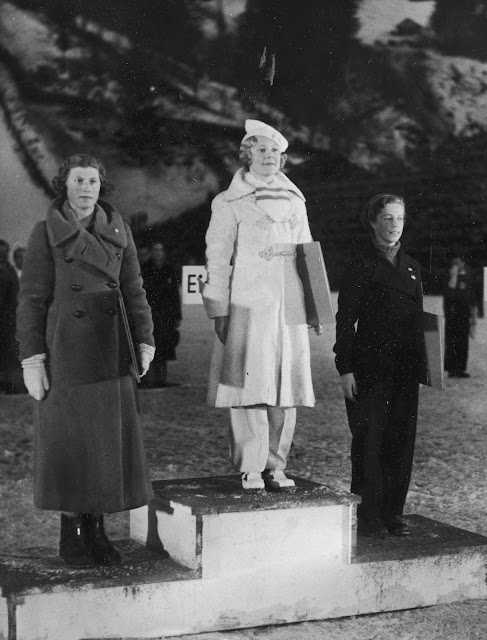
Cecilia Colledge, Sonja Henie and Vivi-Anne Hultén on the podium at the 1936 Winter Olympic Games. Photo courtesy National Archives of Poland.

British skating stars Cecilia Colledge and Megan Taylor had no love lost for Sonja Henie either. Phil Taylor wagered a thousand-dollar bet that his daughter and pupil Megan could defeat Sonja in any fair "challenge test". Cecilia Colledge recalled how Henie would isolate herself from her competitors. "She never talked to us," Colledge remarked. "To her, there were no other skaters. Even on the podium after the Olympics, there were no kisses, no handshakes, not even a word. She never would have considered saying something nice."

Lucienne Bonne at the Palais de Glace in Paris in 1932. Photo courtesy Bibliothèque nationale de France.

Then there was the alleged run-in between Sonja and French skater Lucienne Bonne. Canadian journalist Dick Beddoes recalled, "One likes to think of the night in Paris in 1932, in Jeff Dickson's Palais des Sports, when Sonja Henie, the Olympic Champion from Norway, was skating 'The Dying Swan', to the music of Saint-Saëns. Suddenly, from the balcony, came a serenade on tin whistles. Henie burst into tears - though not until after counting the house - and management announced that the tin whistle claque had been paid for by a rival skater, Lucienne Bonne. Mlle. Bonne denied everything. 'But what of it?' she added. 'This Norwegian nuisance stole my Swan!'"

Cecil Smith. Photo courtesy City of Toronto Archives.

Canada's Cecil Smith, who finished second to Sonja Henie at the 1930 World Championships, claimed that Sonja stole her idea of wearing white boots. In David Young's 1984 book "The Golden Age Of Canadian Figure Skating", Smith recalled, "First came Sonja, swathed in furs. Then came Mother, swathed in furs. Then Papa Henie, with a fur coat and cigar. Then the brother, with long blond hair, carrying Sonja's skates, and behind him, one of the international judges. Sonja walked over to my patch to see what my figures were like, but I said nothing - just smiled... At that time, only professionals wore white skating boots, while the rest of us wore black or tan. I decided I was going to wear white boots in the World Championships. Well, my mother was horrified. She thought it was brash, and the effect on the judges would be too startling, but I did it anyway. Three months later, Sonja was wearing white boots too." Henie later told the press that she wore white boots because they "reminded her of the beautiful snow in Norway".

Photo courtesy "Skating" magazine

Who could forget Olympic Bronze Medallist Vivi-Anne Hultén, whose candid remarks about Sonja Henie around the time of the 1994 Winter Olympic Games in Lillehammer ruffled some feathers. In an interview with "Sports Illustrated" magazine in the 1990s, Hultén recalled, "Look, I have a great admiration for what Henie did... On the ice, she was terrific, a wonderful acrobat, just like a circus princess, a big smile, dressed perfectly. But she was Dr. Jekyll and Mr. Hyde, a very nasty person off the ice.... I'm just telling it like it is." 

A 2003 article from "The Los Angeles Times" relayed several tales of the rivalry between the two famous 1930s skaters with the last name H: "The rift began at the 1933 World Championships, when Hultén finished only two-tenths of a point behind Henie. 'You are not nearly good enough to get second next to me,' Henie screamed afterward, pointing a finger at Hulténs nose. 'I'm so much better than you are. You deserved to be fourth.'" At the 1934 World Championships], that's exactly where Hultén finished.

Vivi-Anne Hultén and Sonja Henie. Photo courtesy Sveriges Centralförening för Idrottens Främjande.

"'Her father arranged it. She was afraid of me," Vivi-Anne Hultén told a reporter from the "Minneapolis Star Tribune". Hultén claimed that Sonja Henie's father made deals with judges at world championships to ensure his daughter's victories. "Papa Henie would go to these places and tell the organizers, 'You can have my daughter (for an exhibition); come up to my hotel room and I'll tell you how we can arrange it. He played poker with them. If he won, he got an appearance fee for Sonja to skate and he got an agreement that the judges would place me no higher than third. I didn't have a chance. I know this is true because one of my best friends was the President of our club in Stockholm, and he told me about it. Back then, the judges were always with the clubs,'" Hultén claimed. 

On a trip to St. Moritz in late 1935 to train for the 1936 Winter Olympic Games, Hultén was detained at the German border for seven hours and searched from head to toe by a guard named Ulrich Schmidt. After she was released, Hultén filed a complaint with Joseph Goebbels, the Reich Minister of Propaganda. Goebbels summoned Schmidt and made him get down on one knee and apologize to Hultén. Schmidt admitted to Goebbels, "A young lady came through before her whose name was Sonja Henie. She told me this girl here would be smuggling jewelry, so we stopped her.'"

Belita Jepson-Turner

In the heyday of Sonja Henie's success as a professional, she was a Hollywood star with her name in lights and a lucrative contract with Twentieth Century-Fox. Belita Jepson-Turner, a multi-talented skater/actress/dancer from the UK, had a contract with Monogram Pictures at the same time. When interviewed by David Jacobs in the 1970s and asked directly about her relationship with Sonja Henie, Belita responded with a coy, knowing smile and a carefully measured reply: “That’s a difficult question. I don’t know that I was a successor. We were quite different in style! She was signed up to Twentieth Century-Fox. They actually offered me a contract for life, for as much money as I wanted, if I never touched skates again." When pressed about whether the two were rivals, she added coolly, "Uh, that’s her opinion, not mine."

Though many of Sonja Henie's rivals had no love lost for her, many of her competitors had positive and nuanced views on her. Melitta Brunner, who finished third behind Henie at the 1929 World Championships, forged a friendship with Henie when she was in Vienna. Sonja also took lessons briefly from Pepi Weiß-Pfändler, Melitta Brunner's coach - and incidentally the former coach of Henie's first casualty, Herma Szabo. Sonja Henie also forged a friendship with young Austrian skater Hilde Holovsky and mourned her tragic death at the age of sixteen in 1933. 

Sonja Henie and Hilde Holovsky

Despite their rivalry, Fritzi Burger-Russell, Cecilia Colledge and Maribel Vinson Owen, among others, were able to find charitable things to say about Henie at times. They recognized her undeniable talent and the role that the powerful machine behind her success, her determined Papa, played in the behind-the-scenes wheeling and dealing of those days.

While skating lore will likely always be laced with larger-than-life tales of Sonja Henie and her ever-watchful father, it's hard to dismiss the chorus of voices from those who shared the ice with her. Surely not every grievance was sour grapes, and not every victory squeaky clean. But what’s equally true is this: love her or loathe her, Sonja Henie reshaped figure skating forever. Without the rivals who pushed her — and sometimes pushed back — the story wouldn’t be nearly as compelling.

Skate Guard is a blog dedicated to preserving the rich, colourful and fascinating history of figure skating. Over ten years, the blog has featured over a thousand free articles covering all aspects of the sport's history, as well as four compelling in-depth features. To read the latest articles, follow the blog on FacebookBlueskyPinterest and YouTube. If you enjoy Skate Guard, please show your support for this archive by ordering one of eight fascinating books highlighting the history of figure skating: https://skateguard1.blogspot.com/p/buy-book.html.